
U-937
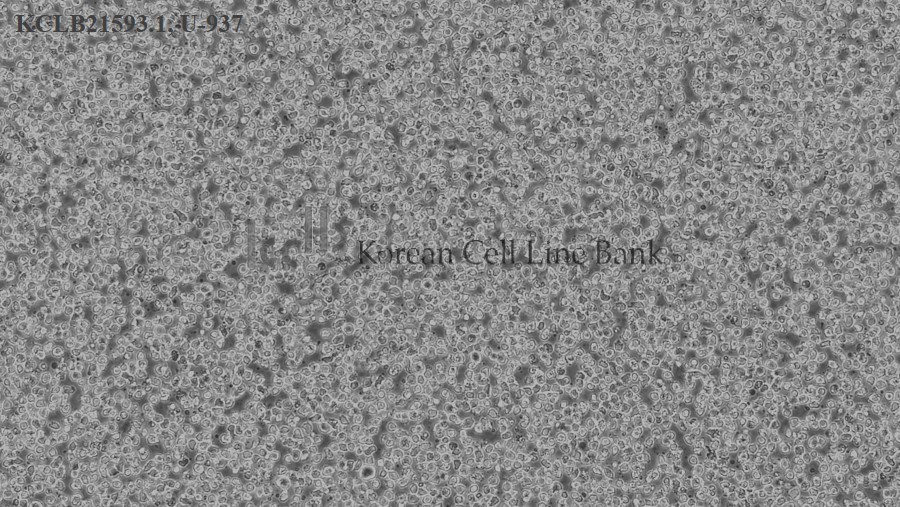
| KCLB NO |
21593.1
|
|---|---|
| Name |
U-937
|
세포주 분양조건
서비스
수량
-
+
| Origin |
monocyte like; histiocytic
|
|---|---|
| Species |
Human male, 37 years old, Caucasian
|
| Receptor |
immunoglobulin (Fc); complement (C3)
|
| Cellular morphology |
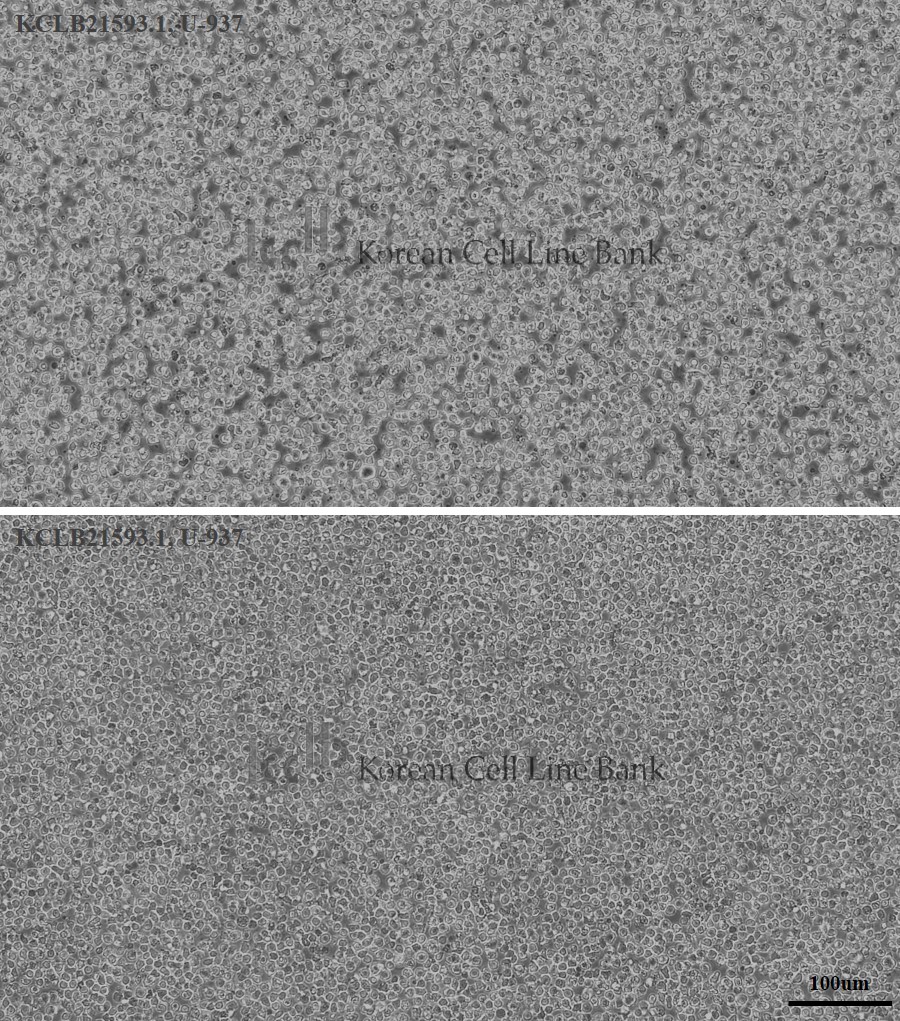
monocyte
|
| Production |
lysozyme; beta-2-microglobulin (beta 2 microglobulin); tumor necrosis factor (TNF), also known tumor necrosis factor (TNF) alpha (TNF-alpha), after stimulation with phorbol myristic acid (PMA)
|
| Growth Pattern |
suspension
|
| vWA |
15
|
|---|---|
| Amelogenin |
X
|
| TH01 |
9.3
|
| TPOX |
8,11
|
| CSF1P0 |
12
|
| D5S818 |
12
|
| D13S317 |
10,12
|
| D7S820 |
9,11
|
준비중입니다.
| freeze media |
RPMI1640, 52.5%; FBS, 40%; DMSO, 7.5%
|
|---|---|
| original medium |
RPMI1640 with L-glutamine (300mg/L), 25mM HEPES and 25mM NaHCO3, 90%; heat inactivated fetal bovine serum (FBS), 10%
|
| kclb media |
RPMI1640 with L-glutamine (300mg/L), 25mM HEPES and 25mM NaHCO3, 90%; heat inactivated fetal bovine serum (FBS), 10%
|
| note |
the U-937 cell line was derived by Sundstrom and Nilsson in 1974 from malignant cells obtained from pleural effusion from a patient with histiocytic lymphoma; studies since 1979 have shown that U-937 cells can be induced to terminal monocytic differentiation by supernatants from human mixed lymphocyte cultures, by phorbol esters, by vitamin D3 by gamma interferon, by tumor necrosis factor (TNF) and by retinoic acid; the cells are negative for immunoglobulin production and Epstein-Barr virus expression.
|
|
J Exp Med, 143:1528-1533, 1976; Int J Cancer, 17:565-577, 1976; Nature, 279:328-331, 1979; International Symposium on New Trends in Human Immunology and Cancer Immunotherapy, Serrou and Rosenfeld (eds), Doin Editeurs, Paris, pp 271-292, 1980; Nature, 292:848-850, 1981; Cancer Res, 43:5862-5867, 1983; Nature, 312:724-729, 1984; Gene Expression During Normal and Malignant Differentiation, Anderson, Gahmberg and Ekblom (eds), Academic Press, London, pp 57-72, 1985
|
|---|

