
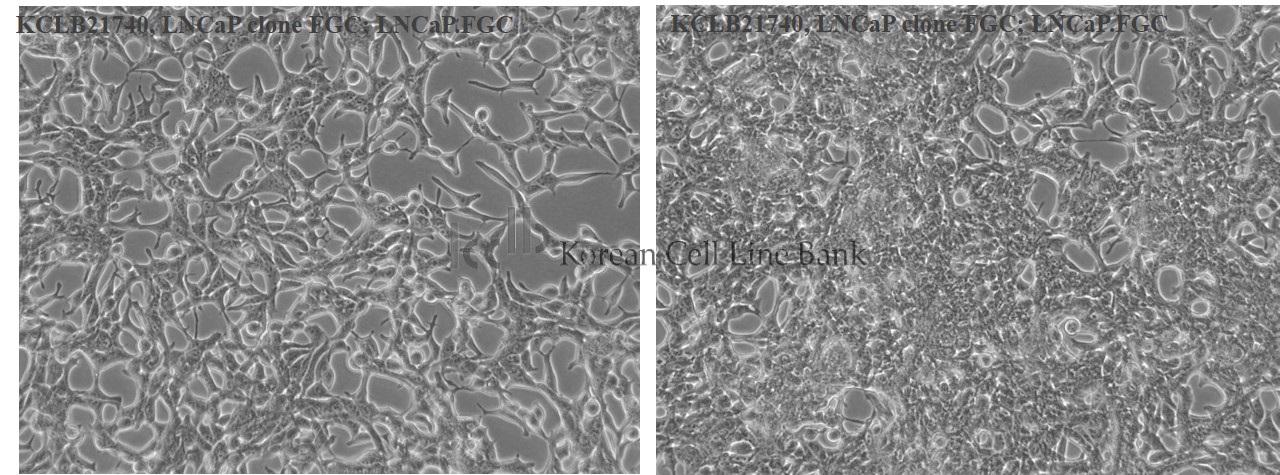
LNCaP clone FGC; LNCaP.FGC

| KCLB NO |
21740
|
|---|---|
| Name |
LNCaP clone FGC; LNCaP.FGC
|
세포주 분양조건
서비스
수량
-
+
| Origin |
prostate
|
|---|---|
| Species |
human male, 50 years old, Caucasian
|
| Tumorigenecity |
yes, in nude mice
|
| Karyology |
pseudodiploid male; seven marker chromosomes
|
| Cellular morphology |
epithelial
|
| Production |
human prostatic acid phosphatase; prostate specific antigen
|
| Growth Pattern |
clusters; lightly adherent
|
| Histopathology |
carcinoma; metastasis to left supraclavicular lymph node
|
| Modal Choromosome No |
46 (33 to 91)
|
| D3S1358 |
16
|
|---|---|
| vWA |
16,18
|
| FGA |
19,20
|
| Amelogenin |
X,Y
|
| TH01 |
9
|
| TPOX |
8,9
|
| CSF1P0 |
10,11
|
| D5S818 |
11,12
|
| D13S317 |
10,12
|
| D7S820 |
9,11
|
준비중입니다.
| freeze media |
RPMI1640, 52.5%; FBS, 40%; DMSO, 7.5%
|
|---|---|
| original medium |
RPMI1640, 90%; heat inactivated fetal bovine serum (FBS), 10% or Dulbecco
|
| kclb media |
RPMI1640 with L-glutamine (300mg/L), 25mM HEPES and 25mM NaHCO3, 90%; heat inactivated fetal bovine serum (FBS), 10%
|
| note |
these cells are responsive to 5-alpha-dihydrotestosterone (growth modulation and acid phosphatase); the cells do not produce a uniform monolayer, but grow in clusters which should be broken apart by repeated pipetting when subcultures are prepared; they attach only lightly to the substrate, do no become confluent and rapidly acidify the medium; growth is very slow; the cells should be allowed to incubate undisturbed for the first 48 hours after subculture; when flask cultures are shipped, the majority of the cells become detached from the flask and float in the medium. Upon receipt, incubate the flask (in the usual position for monolayer cultures) for 24 to 48 hours to allow the cells to re-attach. The medium can then be removed and replaced with fresh medium. If desired the contents of the flask can be collected, centrifuged at 300xg for 15 minutes, resuspended in 10ml of medium and dispensed into a single flask
|
|
The LNCaP cell line - A new model for studies on human prostatic carcinoma, In: Models for Prostate Cancer, G.P. Murphy (Ed.), pp 115-132, Alan R. Liss, Inc. N.Y., 1980; Cancer Res, 43:1809-1818: Cancer Genet Cytogenet, 11:399-404, 1984
|
|---|

